
⸺Infections of the cervical, thoracic, and lumbar spine⸺

Infections of the cervical, lumbar, and thoracic spine

Spinal infections are rare. They can weaken the spine’s ability to bear weight and make it unstable. Physicians distinguish between primary infections and secondary infections that develop following an infection elsewhere in the body or in the spine itself. Spinal infections can also occur after surgery, although postoperative wound infections occur in fewer than 1% of cases.


Nonsurgical treatment

Depending on how extensive an infection is and which parts of the spine are affected, it may be treated without surgery using antibiotics and pain medication. The areas of infection must first be located using MRI, CT, or x-ray imaging.

Surgical treatment

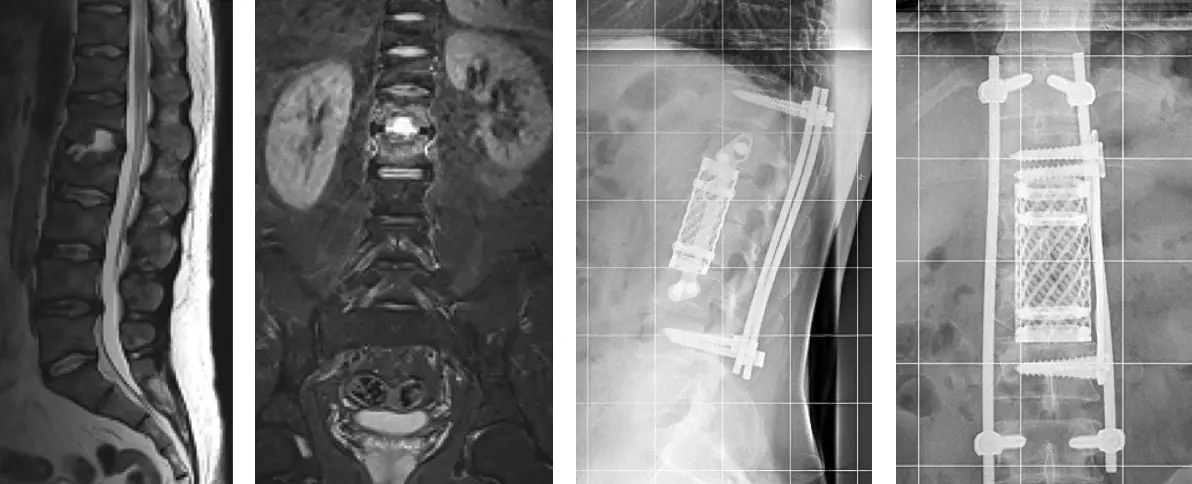
Patients will require surgery if the infection has weakened the bone, caused neurological problems, or is spreading in a potentially dangerous way. The infected tissue is removed and the affected vertebrae are stabilized. During surgery, tissue samples are taken to help select the most effective antibiotic. Minimally invasive techniques are often used.
Spinal infection FAQs

1What is a spinal infection (spondylodiscitis or osteomyelitis)?
A spinal infection is a bacterial infection of the vertebrae or intervertebral disks. Bacteria may reach the spine through the bloodstream from an infection elsewhere in the body. Spinal infections may also occur after surgery or when the immune system is weakened.
2What are the symptoms of a spinal infection?
People with a spinal infection may experience severe, persistent pain that does not improve with pain medication, as well as fever, loss of appetite, and neurological problems.
3How is a spinal infection diagnosed?
Physicians use blood tests to measure inflammatory markers, an MRI of the spine, and a neurological examination to diagnose the condition. They can also use CT or x-rays to aid in the diagnosis.
4How can infections be treated?
Treatment starts with intravenous antibiotics, followed by oral antibiotics, together with pain medication. Testing a tissue sample or blood culture can identify the pathogen and allow physicians to select an effective antibiotic.
5When is surgery required for a spinal infection?
Surgery is recommended if neurological problems develop, large abscesses form, pain does not improve with treatment, or the spine becomes unstable.